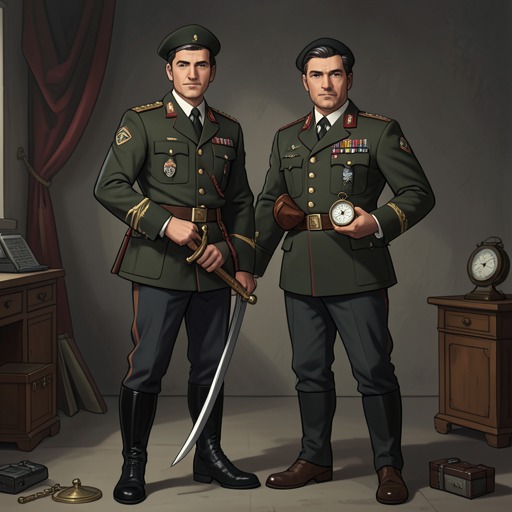
Uncle Toby and Corporal Trim
The Life and Opinions of Tristram Shandy, GentlemanUncle Toby and Corporal Trim share a close bond shaped by service and military companionship but sustained by reciprocal affection. Trim serves his master and addresses him with deference; Toby, in turn, listens attentively, trusts Trim’s judgment and storytelling, and recognizes the compassion beneath his manner. Their exchanges move easily between shared military projects, personal recollections, and practical plans, making their relationship one of the book’s most consistent forms of mutual support.
Identity and Foundations
Trim is Toby’s corporal and attendant, but the bond between them exceeds formal rank. Toby regards Trim as a companion whose stories have helped him through both painful and grave hours. He says that Trim has seldom told him a bad story, valuing not merely the entertainment but the personal experience behind the tales. Trim explains that, with one exception, his stories are true because they concern himself. Their shared history gives Toby a special reason to listen: Trim’s narrative is also a record of the life and attachments that have brought the two men together.
Their intimacy does not erase their roles. Trim continues to address Toby as his honour, while Toby gives orders and rewards him for assistance. Yet the formality is softened by easy confidence. When Trim asks permission to lay out a plan for approaching Widow Wadman, Toby welcomes the proposal and gives him a crown to begin his commission as aide-de-camp. The gesture turns their established military hierarchy into affectionate collaboration: Toby remains the commander, but Trim is trusted to help shape the action.
Storytelling and Mutual Attention
During the dismantling of the fortifications at Dunkirk, Trim explains that he has not whistled, sung, laughed, cried, or told Toby stories from the beginning of the demolition to its end. The silence marks how much their usual companionship depends on conversation. Toby accepts Trim’s judgment that it was a pity both to destroy the works and to have let them stand, then encourages him to tell a story. He asks that it be neither wholly merry nor wholly grave, attentive to his own state of mind and to the effect the story may have on its listener.
Trim’s account of the young Beguine makes that attentiveness reciprocal. She cares for him while he recovers from a knee wound, tending to him and remaining near during his illness. Trim remembers her kindness and his own confusion about the feeling it produced. As he describes her hand, Toby gently interjects, and Trim cannot help smiling even while presenting the memory as serious. Toby does not shut down the story or mock his companion; he invites him to continue and listens as the recollection shifts from the Beguine’s care to its emotional consequences.
The tale also becomes part of Toby’s developing courtship with Widow Wadman. After Trim finishes, she leaves her arbor and approaches Toby’s sentry-box while Trim has been sent to clear away the military tools. The timing gives the story a practical effect: Trim’s recollection has altered the atmosphere around Toby, and Widow Wadman takes advantage of the opening. Their friendship thus intersects with courtship without reducing the story to strategy; Trim contributes by telling a personal history, while Toby’s willingness to hear it helps create the moment in which the next approach can be made.
Affection, Grief, and Protection
The tenderness between the two men is especially visible when Trim recounts his brother Tom’s misfortunes. Toby responds feelingly to the news that the light-hearted Tom has suffered. When he says that Tom resembled Trim, the corporal blushes; gratitude and sorrow rise together in his tears. Toby takes hold of the breast of Trim’s coat, ostensibly as though to ease his lame leg, but the narration identifies a finer feeling behind the gesture. He remains silent for a minute and a half before Trim resumes the account. Their feeling is communicated less by explanation than by this pause, the touch, and the tears they share.
Their concern for others grows out of the same humane understanding. In Lisbon, Toby sees a persecuted girl and argues that her vulnerability makes her more, not less, deserving of protection. He extends that principle to her community, describing oppression as a turn of fortune that might change hands. Trim answers with agreement, and Toby affirms that the brave should not use power unkindly. The statement is not merely a general maxim: it defines the ethical purpose Toby assigns to the military knowledge he and Trim have practiced together.
Shared Principles and Narrative Significance
Toby explains that their military exercises on the bowling-green are intended to restrain ambition and protect the lives and fortunes of the few from the plundering of the many. He hopes that when the drum sounds, neither he nor Trim will lack the humanity and fellow-feeling to turn and march. As he speaks, Toby faces about and marches down the avenue; Trim follows close behind, shouldering his stick. The physical movement makes their principle visible as a shared commitment rather than an abstract claim.
Their bond also gives military imagery a second life. Toby and Trim can plan an approach to Widow Wadman in the language of commissions, aides-de-camp, and attacks, but the same habits are tied to protective rather than predatory aims. Their play at siege and maneuver sits beside the real care they show the sick and vulnerable. By making the pair’s friendship both practical and emotionally responsive, the narrative presents companionship as a means through which military discipline may be redirected toward mercy. Their loyalty does not depend on equal status: it is enacted in Toby’s trust and protection, and in Trim’s faithful attendance and readiness to follow.